How to Secure Data Governance Before Implementing AI
16 September 2025

Reading time: 6 minutes

Artificial intelligence is no longer just a futuristic concept — it’s a part of everyday business operations. It automates, personalizes, and provides a competitive edge. But for all of this to work, we need something fundamental: high-quality data. That’s why securing data before implementing AI is so crucial.
And here’s the challenge: 81% of data experts admit their organizations still face serious data quality issues in AI projects, and 90% of managers say leadership doesn’t pay enough attention to it.
Simply put — it’s not the lack of technology, but the lack of data order that causes many AI initiatives to fall short. If you don’t ensure data quality and governance before launching, even the most advanced models can fail — not just technically, but also in terms of reputation and business impact. That’s why we’re guiding you further — in this article, we’ll show you why securing data before implementing AI is essential.
Data Governance – Definition and Importance
Data governance isn’t just a set of procedures — it’s a strategic approach that treats data as one of the organization’s most valuable assets. It’s the foundation that ensures data becomes a reliable, secure, and valuable resource supporting business decisions, automation, and digital transformation.
In practice, this includes:
- Data security and quality policies — clearly defining how to protect data from unauthorized access and ensure its integrity.
- Roles and responsibilities — establishing who manages, controls, and uses the data.
- Monitoring and audit mechanisms — enabling detection and response to irregularities in data processing.
- Regulatory compliance — such as GDPR, ISO standards, and other legal frameworks for responsible data handling.
- Tools for access and metadata management — including data catalogs, access control mechanisms, and systems for tracking data sources and history.
In short: securing data governance before implementing AI is the foundation that ensures AI projects won’t compromise security, create data chaos, or expose the organization to legal consequences.
The Hidden Dangers of Weak Data Governance
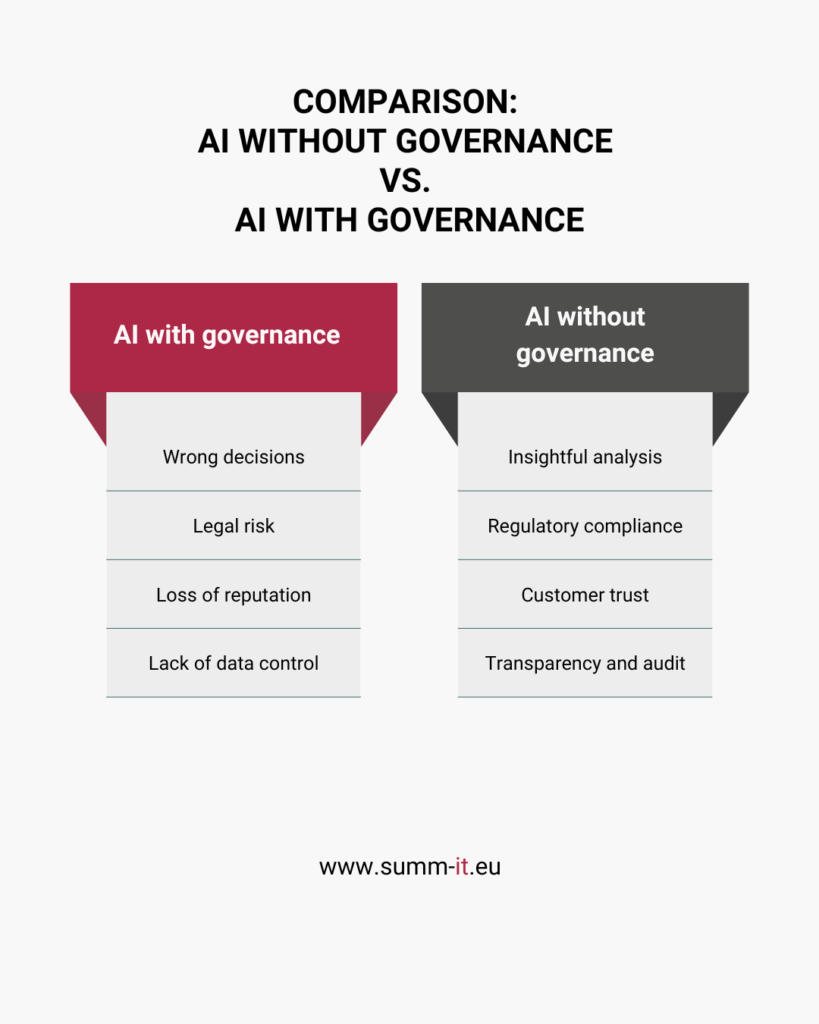
Organizations that implement AI without proper governance face:
- Decision-making errors — models learn from outdated or incorrect data.
- Legal issues — using data without consent or in violation of regulations.
- Reputation damage — customers and partners lose trust.
- Remediation costs — fixing systems and paying penalties.
Example:
An e-commerce company implemented an AI system for offer recommendations but ignored the lack of marketing consent from some customers. The result? Complaints, financial penalties, and negative coverage in industry media.
Data Audit – The First Step
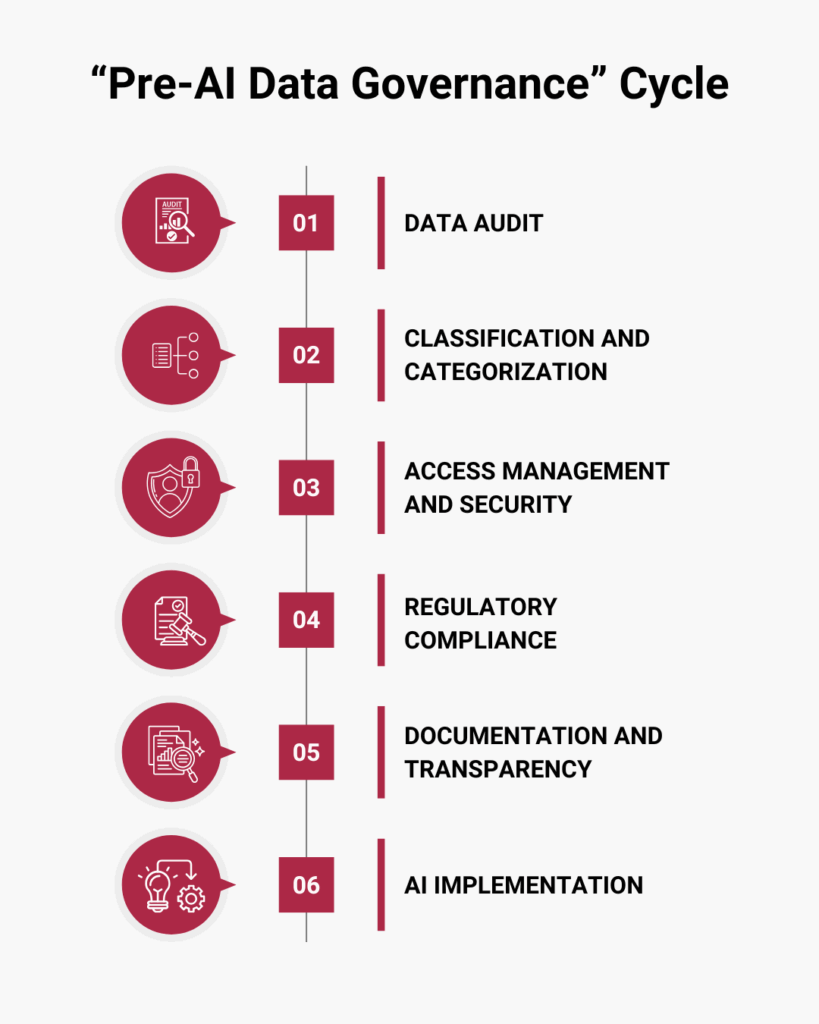
A data audit is a crucial stage in preparing an organization for the implementation of artificial intelligence. It helps answer key questions:
- Where does the data come from?
- Who owns the data?
- Is it current, consistent, and complete?
- Can it be legally used to train AI models?
Thanks to the audit, a company avoids situations where AI operates based on unverified information.
Need Support with a Data Audit?
summ-it offers comprehensive audit services across both on-premise and cloud environments (Azure, AWS, Google Cloud, Oracle). With years of experience and a proprietary audit program, summ-it specialists identify bottlenecks, optimize performance, and ensure data security.
Tools supporting data audit
Microsoft Purview, Collibra, and Talend are advanced platforms that support data auditing — enabling the identification of data sources, access control, data quality assessment, and regulatory compliance. With these tools, companies can effectively manage information, eliminate risks associated with incomplete or unlawfully used data, and build a solid foundation for AI projects.
Data Classification and Categorization
Data varies in its level of sensitivity — operational data is protected differently than medical or financial data. Data classification allows organizations to assign appropriate protection and access policies to each type of data. Before implementing artificial intelligence, it is crucial to understand which data is critical and requires special protection — this is where securing data governance before AI deployment helps avoid risks related to unauthorized access or privacy violations.
For example, in the retail sector, purchase history data can be analyzed by AI models, but must be clearly separated from customers’ personal data to avoid privacy breaches. Similarly, in healthcare, patient medical records are classified as highly confidential and require advanced protection measures such as encryption and access control to ensure compliance with regulations like HIPAA.
By implementing proper data classification, organizations can effectively manage access, ensure regulatory compliance, and minimize risks associated with AI usage.
Access Management and Security
The principle of least privilege should be the gold standard: employees should only have access to the data that is strictly necessary for their roles.
Protection Mechanisms:
- Role-based access and permissions within systems
- Data encryption at rest and in transit
- User activity monitoring
- DLP systems (Data Loss Prevention)
Examples of Tools:
- Azure Active Directory
- Okta
- Databricks Unity Catalog
Regulatory Compliance
AI doesn’t operate in a vacuum — every company is subject to regulations that define how data must be processed. Key regulations include:
- GDPR – personal data protection in the EU
- ISO 27001 – information security management standard
- HIPAA – protection of medical data in the US
Example:
In a pharmaceutical company, patient data must be pseudonymized. Without this, implementing AI to analyze clinical trials would be illegal.
Transparency and Documentation of AI Processes – Securing Data Governance Before AI Implementation
AI is often perceived as a “black box.” Data governance helps introduce transparency through:
- Documenting data sources
- Describing processing methods
- Defining the decision-making criteria of algorithms
Example from HR:
If AI is used to analyze candidate CVs, the selection criteria must be clearly defined and documented — this protects against accusations of discrimination and is a key part of securing data governance before implementing AI.
Examples of AI Implementation Across Industries
- Finance: A bank audits customer data before implementing AI for credit risk assessment.
- Retail: A retail chain separates purchase data from personal data to safely personalize offers.
- Manufacturing: Machine sensor data analyzed by AI is accessible only to the technical team.
- Healthcare: AI analyzes medical images, while patient data is pseudonymized.
- HR: AI supports recruitment, but decision-making processes are transparent and well-documented.
In each of these cases, securing data governance before AI implementation is essential to ensure regulatory compliance and privacy protection — regardless of the industry.
Tools Supporting Data Governance
- Microsoft Purview – data cataloging, compliance, classification
- Collibra – data quality and policy management
- Talend – data integration and quality control
- Databricks Unity Catalog – access and metadata management
- Azure Active Directory – identity and permission control
Tools like Microsoft Purview, Collibra, Talend, and Databricks Unity Catalog support securing data governance before AI implementation by enabling classification, access control, and regulatory compliance.
Strategic Recommendations for Companies in the Area of Data and AI
Conduct a data audit before starting an AI project – this is the first step to securing data governance prior to AI implementation.
Implement data classification and security policies.
Ensure full compliance with legal regulations.
Document all processes related to data and AI.
Use dedicated tools supporting governance.
Educate teams – employees should understand why data is crucial.
Appoint Data Stewards responsible for overseeing data in specific areas.
Summary
Data governance is not an add-on but a prerequisite for effective and secure AI implementation. Ensuring proper governance before deploying AI allows companies not only to minimize legal and financial risks but also to build a competitive advantage.
Before you launch your first AI model, ask yourself: are my data ready?
Author of the article